This section features FortifyIQ's academic publications, presenting AES protection techniques against side-channel and fault injection attacks and side-channel attacks on SHA-2-based HMAC.
Learn MoreHigh-assurance cryptographic implementations of AES, HMAC, PKA, PQC, CryptoBox, and Root-of-Trust families, plus software libraries, all exceptionally efficient (PPA-optimized).

See MoreProvide high-assurance cryptographic protection, engineered for AVA_VAN.5 compliance and designed for high-security certification.
Secures both new and already-deployed devices, including those without hardware countermeasures, and is proven in millions of systems.
Provides ultra-strong protection against SCA, FIA, and cache attacks.
What are side-channel and fault-injection attacks, and why would your device need protection against them? Etc.
Provides a comprehensive suite of post-quantum cryptography hardware, including CryptoBoxes, IP cores, and Root-of-Trust modules.
Provide high-assurance cryptographic protection, engineered for AVA_VAN.5 compliance and designed for high-security certification.
CryptoBoxes and Roots of Trust (RoTs) integrate post-quantum and classical cryptography in a unified, high-assurance architecture.
Why post-quantum cryptography matters? Etc.
The most popular myths and facts about post-quantum cryptography.
Enables engineers to evaluate and strengthen hardware designs against fault injection attacks, e.g., DFA, SIFA, and AFA.
Pre-silicon EDA tool suite designed to identify, analyze, and mitigate side-channel vulnerabilities in hardware designs from RTL.
Mathematically sound and practically validated patented/patent-pending countermeasures, ensuring resistance to the most advanced physical attacks.
How does FortifyIQ validate resistance to side-channel and fault-injection attacks? Etc.
Resilient cryptographic protection for payment systems, digital banking, and secure financial infrastructure.
Secure cryptographic foundations for identity systems, defense infrastructure, and digital government platforms.
From payment cards to e-passports, SIMs, and digital ID tokens, smart cards and digital identity solutions power critical transactions.
Securing network infrastructure, subscriber identity, and cloud-native telecommunication systems.
Automotive Cybersecurity IPs and Tools for ECUs, ADAS, AV and In-Vehicle-Infotainment (IVI) Systems.
Robust, certifiable security solutions for next-generation industrial automation and control systems.
Cryptographic security tailored to the needs of energy systems: robust protection against side-channel and fault injection attacks.
Safeguarding energy, water, and transportation systems with certifiable hardware and software security.
Cryptographic protection engineered for the longevity, safety, and regulatory demands of rail and transportation systems.
Ultra-high-throughput, physically secure cryptographic IP for cloud and data center silicon.
Cryptographic protection for IoT systems, with unmatched resistance to side-channel analysis and fault injection attacks.
Secure cryptography and OTA updates for ultra-constrained, mission-critical medical electronics.
Robust, efficient cryptographic protections for media platforms that resist real-world physical attacks with minimal performance tradeoffs.
Cryptographic solutions purpose-built for silicon IP protection, licensing enforcement, and clone detection.
In healthcare, we provide comprehensive cryptographic solutions — from traditional to post-quantum cryptography.
This section features FortifyIQ's academic publications, presenting AES protection techniques against side-channel and fault injection attacks and side-channel attacks on SHA-2-based HMAC.
Learn MoreThis section demonstrates how FortifyIQ validates cryptographic solutions, compares ours against other secure cores, and showcases FortiEDA for evaluating and developing secure designs.
Learn MoreOur explanatory videos break down complex hardware security concepts into clear, visual stories, showcasing how FortifyIQ's technologies detect and prevent side-channel and fault-injection attacks.
Learn MorePioneers in hardware-based security innovation, combining cutting-edge cryptography with advanced defense mechanisms, dedicated to safeguarding the digital world’s most critical assets.
Learn MoreOur services ensure that security, performance, power, and area are balanced optimally, without compromising certifiable high-assurance protection against side-channel and fault-injection attacks.
Learn MoreAt FortifyIQ, our R&D team is a unique blend of industry veterans with deep expertise in mathematics and cybersecurity, alongside talented young engineers who bring fresh perspectives and innovative thinking.
Learn MoreWe seek exceptional individuals who are passionate about tackling the toughest challenges facing hardware manufacturers today and ready to take on whatever comes next.
Join Us


Milipol 2019 Event Review

Milipol—an acronym for “Military and Police”— is the largest European event showcasing innovation and invention in homeland security. For four days every other year, 30,000 industry stakeholders and over 1,000 exhibitors from 150+ countries attend Milipol to network, share the latest industry news and breakthroughs, and procure or sell everything from tanks and armored vehicles to uniform fabrics, supplies, and surveillance
and countersurveillance equipment.
As first-time exhibitors, we were initially surprised that Milipol was such a long event – four days of expo, workshops, meetings, and speaking opportunities. However, given the number of participants from so many countries, as well as the massive volume of information disseminated, it was easy to see why the event lasted as long as it did.
Milipol is a tradeshow where traditional hardware—particularly tangible military and homeland security equipment—rules. Virtually every booth offers something you can hold in your hands: grenades, surveillance cameras, drones, tactical gear, shields, etc. This year, however, there was a noticeable spike in software, AI-based products, and services – new products that are built to thwart growing cybersecurity threats to homeland security.
The expo receives 167 official delegations from 68 countries made up of experts from different procurement areas and representatives hired to investigate the latest industry innovations on behalf of the buyers. Major defense contractors sent numerous teams to pick up the newest technologies.
For example, we met several teams from the giant French high-tech and manufacturing company, The Thales Group, who oversee diverse business sectors and projects. Every day different company representatives would stop by our booth, enriching their knowledge of new global technologies.
On the expo floor, large countries like China, Germany, Israel, and the U.S., as well as some smaller ones, like Croatia, have organized country pavilions where multiple exhibitors share the space and resources.
As you might expect from a homeland security conference, not every exhibit was open for display. One section of the exhibit floor was closed off to the public, concealed under a giant opaque tent. This classified pavilion was protected by security 24/7, and unauthorized personnel were strictly prohibited from entering. Considering that accessible exhibits featured a broad array of defensive, offensive and counterintelligence tools—including sophisticated weapons systems and drones—it’s intriguing to consider what products were too classified to display.
FortifyIQ went to Milipol to showcase to the European hardware makers and designers that there is a way to solve for one of the most challenging weaknesses of electronic and communication systems: vulnerability to the side-channel attacks.
At the event, FortifyIQ demonstrated the world’s first comprehensive solution suite enabling chip and OEM manufacturers to protect existing and future electronic products against these insidious threats—namely Differential Power Analysis (DPA), Simple Power Analysis (SPA), Electromagnetic Emissions (EME), and Fault Injection (FI).
Milipol designates an area for startups like FortifyIQ to congregate and present their innovations. Exhibiting alongside other startups, FortifyIQ embraced the opportunity to network with teams developing some of the most advanced and innovative technologies of the future.
The FortifyIQ team made two on-stage presentations about side-channel attacks and the threats they present to homeland security systems.
Our team also had the opportunity to give press interviews and spread the word to the hundreds of attendees who stopped by our exhibit throughout the 4 days.
Milipol Innovation Awards are judged by a panel of 15 experts assisted by external specialists as needed. The jury collects detailed documentation
to determine if applicants have in fact developed an innovation that is both impactful and has high commercial potential in its field.
In prior years, the award categories were limited to material goods typically procured in homeland security:
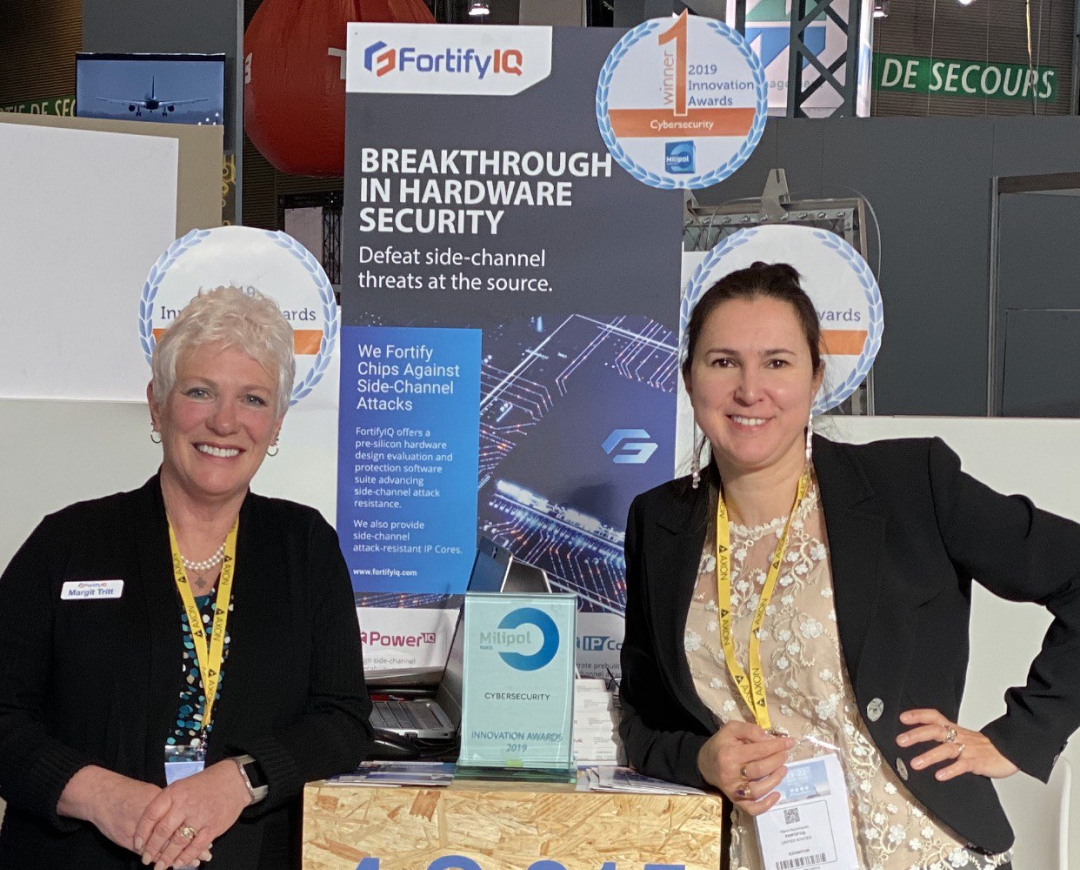
In 2019, the organizers added the new Cybersecurity Innovation Awards category to reflect the changing nature of homeland security challenges and opportunities underscored by the proliferation of cybercrime and cybersecurity.
A total of 162 companies applied in 2019, doubling the number of submissions from 2017.
Winning 1st place in the Cybersecurity category was an incredible honor, especially considering we were competing against some of the most innovative companies in the world.
This recognition shows the value experts place on hardware security, which is often overlooked in favor of better-known safeguards for software, and highlights the renewed emphasis on protecting critical infrastructure equipment, including military, utilities, perimeter security systems, etc. from side-channel attacks on hardware secure elements.
Milipol features an impressive array of products and solutions whose often intimidating appearance and unconcealed functionality should inspire fear and reservations in wannabe terrorists and criminals.
While a city or federal administration can install anti-truck concrete blocks and barriers, CCTV networks to track and recognize faces, and fly drones over secure perimeters or prisons, these necessary physical safeguards are primarily reactive measures to the types of attacks that have been successful
in the past (e.g. trucks running over the pedestrians in major cities around the world).
Unfortunately, they do not protect against attacks that are unknown today, or against any type of cyber threat, or an attack mounted against critical infrastructure and day-to-day city operations.
Driven by technological innovations, every year cyberattacks increase in frequency and impact exponentially. There’s little doubt that cyberattacks
on critical infrastructure will continue to rise, exploiting accelerating digitization, IoT, and a relatively easy access to public targets.
Although minor in present times as compared to attacks against businesses, we predict that hybrid warfare and cybersecurity will be a leading factor
in homeland protection. We already observe that warfare is shifting away from the traditional battlefield and increasingly being waged in cyberspace.
During the week following Milipol, a brute force attack on a Dresden jewelry vault resulted in the loss of priceless royal jewels. This took place in Germany, where police or private security have access to virtually any product or service at their disposal in order to prevent and stop any attacks.
This major security breach illustrates the lack of a risk-based approach to the safeguarding of valuables in a critical facility. The protective measures put in place should commensurate with the value of the protected object. Having the advanced tools at your disposal works only when used in conjunction with the risk-based defense & resource allocation model.
Clearly, the measures implemented to safeguard the valuables were inadequate. Similarly, the current protection methods against side-channel attacks on a hardware secure element are insufficient.
While the last two decades have seen massive investments in software security, protecting electronic hardware—the foundation of cybersecurity—has largely remained an afterthought.
As we learned from talking to representatives from every continent and across many industries, the risk of side-channel attacks on hardware
is little understood—making such attacks even more dangerous. You can’t protect against a threat that isn’t well understood or is not clearly identified.
The participants who had some understanding of side-channel attacks agreed that current safeguards placed by most manufacturers of microchips
and systems-on-chip (SoC) are dangerously inadequate.
The threat that loss of control over the hardware can lead to potential losses of commercial and state secrets, financial loss, and damage or destruction
of property and lives, is underappreciated in the cybersecurity industry, and among buyers of equipment which should be resistant to side-channel attacks.
FortifyIQ’s mission at Milipol and other similar events is to educate manufacturers and end-users beyond the small circle of cryptographers and hardware security engineers about the threats of side-channel attacks on secure elements of hardware—destructive attacks that are often undetected.
Going forward, FortifyIQ will be attending similarly valuable events that attract manufacturers and buyers of security and infrastructure equipment to educate them about the need to demand well-protected devices and silicon microchips from their suppliers.
FortifyIQ is the inventor of the world’s first comprehensive solution suite that enables chip and OEM manufacturers to protect existing and future electronic products against side-channel attacks, namely SPA (Simple Power Analysis), DPA (Differential Power Analysis), and FI (Fault Injection).
FortifyIQ develops the most accurate and precise pre-silicon trace simulator, side-attack vulnerability analyzer and remediation-advising software for secure element fortification, while the product is still in its design stage. FortifyIQ offers IP Cores for electronic and IoT devices which have already been fortified against side-channel attacks.
FortifyIQ is headquartered in Newton, MA.